Nov 19th takeaways
Nobody has AI research figured out yet - but there's lots of excitement about the opportunities.
Notes from our evening of panel talks with senior insights leaders about the role of AI in insights, November 19th, 2026.
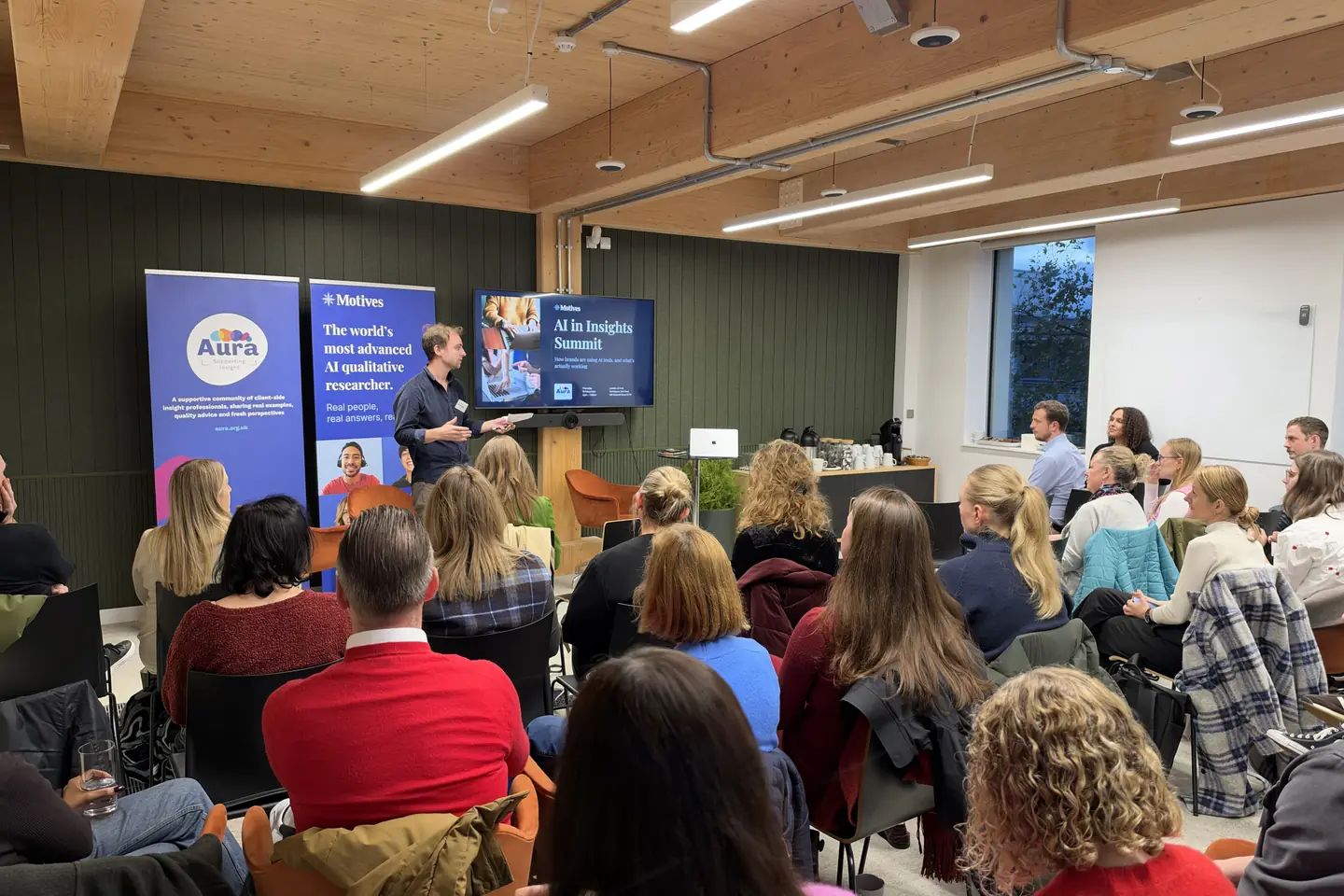
Last Thursday we hosted an AI in Insights event with Aura at our offices in London. Thank you to everyone who joined us, and especially to our panellists for being so open about what's worked, what hasn't and what they're still figuring out.
Speaking to many of the attendees afterwards, it was clear that they felt reassured to hear that they were not alone in trying to figure out AI research. Our event highlighted that every team is learning as it goes, trying tools, getting some things wrong and working out the rules along the way. People also told us how useful it was to hear the specific tips and tricks others have picked up, so we've pulled the best of them together here for those of you who couldn't make it.
Here are the 6 highlights we're still thinking about:
1. AI is making research happen that wouldn't have happened before
Every research team has a list of questions that matter but never quite made it. That's not because they weren't important; it's because something else simply took priority or the budget.
That's changing. When one of our panellists compared the projects their team now runs with AI against what they would have done before, they found research that simply wouldn't have happened otherwise.
And those questions often turn out to be bigger than they looked. Something can seem minor from inside a business and be a real problem for the customers living with it, which means fixing it can pay off far more than anyone expected.
In our fireside chat, we heard how a question that had felt minor, how to improve low food scores in hospitals, turned into a big commercial impact with new menus and new meals, thanks to a research project that wouldn't have happened without AI. A question about clinic delays, which probably wouldn't have been researched at all in the past, has grown into a whole series of work, with seven projects now live.
2. AI research can make a business more human
It might sound counterintuitive, but AI research can actually make a business more human. Our panellists spoke about how, in the past, plenty of business decisions were made without hearing from customers at all, because there wasn't the time or the budget to ask.
The speed that today's AI research unlocks can help change that. One panellist described testing during creative development, at stages where the production pipeline would never have left room for research before.
The value isn't the faster turnaround in itself. It's that customers and prospects stay at the core of the decisions you make, while there's still time to change course. Picking up a mistake before launch costs far less than rushing to hit a timeline without researching and discovering the mistake afterwards.
It also puts the voice of the customer directly in front of the business. A conversation in a boardroom about something that isn't working, or even a quote on a slide, is easy to skim past. A customer on video saying "this really isn't working" is much harder to ignore, and AI moderation tools now make that possible at pace. We heard how having the right clip at the right moment made it easier to make the case for a decision and get stakeholders to buy in.
3. Wider access to insight makes researchers more important, not less
It isn't only research methods that are shifting. What research produces at the end is shifting too, from a static report to something the business can keep coming back to.
One panellist spearheaded exactly that: a knowledge hub where all of the team's past research lives, intended as a living, breathing resource that anyone in the business can query. It seemed a great way to make research easier to engage with and use across the business. What they didn't expect was to find research findings being quoted out of context, with their name attached to conclusions they hadn't seen.
It showed how easily research can be bent out of shape once it travels, and why the insight function still needs to be its custodian. Insight teams know how a study was designed and what it can and can't support. They know what can be said with confidence from the work already done, and where a question needs more research. And they know which story the business needs to hear and how to frame it so it's relevant..
4. AI is changing what it takes to thrive as an insight professional
A consistent theme from our panel on the future of the Insights role was that insight teams have been through change like this before: research moving online, new ways of reaching customers, new methods. Each time there was worry about what it meant for the profession, and each time the work changed rather than went away.
This time, the growing role of AI in research is evolving the skill set it takes to thrive. The panel pointed to a few skills that matter more than ever:
- Analytical skills. Teams are handling more data than ever, across qual, quant and lots of consumer touchpoints. The value is in pulling it together and separating what matters from the noise.
- Business storytelling. This means setting up research with the business context in mind, then turning findings into the story the business needs to hear to make its decisions.
- Stakeholder management. With so many new tools around, and the desire to adapt and move quickly, insight teams need to be the guiding light. That means helping the business see what's worth exploring, what's just noise, and where a method doesn't fit yet.
- Doing more with less. Teams are often smaller and expectations are higher, so staying on top of a lot at once is now part of the job.
5. Transparency is what builds trust in AI tools
Somewhere along the way, insight professionals picked up a side gig as AI tool testers. It's a whole new area to upskill in, and from what we heard on the night, people are doing a great job of it.
All that testing has turned up a few cautionary tales. There are plenty of flashy tools out there, but it was only once teams looked into the detail that they realised some train on your data, and that the terms and conditions can give the provider ownership of it.
With some AI methods and tools, panellists found it hard to get a clear picture of what the model was trained on or how its outputs had been validated. Trusting the results means taking a leap of faith, and nobody wants to do that when a business decision is riding on it.
Our panellists shared some of the questions they now ask any AI provider:
- Do you train your models on our data?
- Who owns the data and the outputs?
- What was the model trained on, and how are its outputs validated?
- How do we know a finding isn't hallucinated, and what controls keep it grounded in the source?
- When we run into issues, what support will be in place?
If a provider can't answer these plainly, that tells you something. They're questions we'd welcome from any client, too.
6. "AI research" isn't one thing, so say which kind you mean
An audience member made a point that stuck with the room: "AI research" gets used as if it's one thing, and it isn't. Synthetic personas, where AI stands in for the customer, are very different from AI-moderated interviews with real people, and different again from AI-assisted analysis or a research knowledge base. Each answers different questions and carries different risks.
These differences are worth calling out, because people bring their own preconceptions to the phrase. A stakeholder who hears "AI research" may picture synthetic personas when you mean real customers interviewed by an AI moderator, and trust the findings less (or more) than they should. Naming the kind of AI you're using or proposing, and why, takes the guesswork out.
Preconceptions also change with experience. We heard two examples on the day:
- Stakeholders who were hesitant about AI research at first are now the ones asking for it to be commissioned.
- A customer who said they wouldn't take part in an AI-moderated interview was convinced to give it a try, completed the entire interview and ended up giving the AI moderator a heartfelt thank you.
So don't let "AI research" do the talking for you. Whether you're presenting a finished study or making the case for a new one, say exactly what kind of AI is involved, show people what it looks like, and let them judge it on that. Buy-in is much easier to win when people know what they're being asked to back.
Wrapping up
As we wrap up 2026, one thing seems clear: nobody has this all figured out yet. But by comparing notes, continuing to upskill and leaning into what AI makes possible, we'll all build more customer-centric businesses.
What's the research your team has always wanted to do but never could? We'd love to hear it: hello@motives.ai